The Supportive Nudge: Breastfeeding Journey

Having done her BE in Computer Science and worked in the IT industry for 10 years, Soumya Suryakumar chose to slow down when her son, Aaryan, was born. She resigned from her job to spend more time with him. While at home, Soumya did not stop following her love for trekking with the Bangalore Trekking Club (BTC) and learning Bharathanatyam. 1. Soumya, tell us a little about how your pregnancy went. I had a difficult pregnancy. At 6 and half months, due to a short cervix, I had to get a cerclage done to add some stitches. Thankfully, I met my doctor at the right time and it was diagnosed soon. I was on bed rest post-surgery. Up until the operation, I was quite well read about pregnancy and felt in control. I like to have things in control. But the surgery threw me off and caused a lot of stress for the next few days. I realized it was taking an unnecessary toll on me and I need to just go with the flow and not worry about having things on a schedule. My stitches were removed in the 37th week and my son was born in the 39th week. Due to all the injections post operation, labour was very slow and the hospital environment just drained me out emotionally. I went in for a C-section 12 hours after my water broke. When I look back, I wish I had spoken to people about my cervix issue and worked out ways to have a natural birth. People around me were also far from motivating; they were so sure that I cannot handle a natural birth. It just brought down my confidence further. 2. I am so sorry you had a hard time. Was the start of breastfeeding easier? I wish. It was like going from the pan into the fire. My son was shown to me only in the operation theatre. There was no immediate skin-to-skin contact and I was not even aware of its importance. Due to the pain from the stitches I was not able to get up and sit and my family kept holding the baby. I remember yelling on the second day to please let me hold my son. During my pregnancy, in the 5th month, the doctor saw that I had inverted nipples so she gave me a syringe and asked me to do an exercise every day of pulling my nipple out. It didn’t help much. I still struggled to breastfeed the first 5 days that I was in the hospital. While my son was ready to latch, I struggled with positioning him. Also, I was told I won’t have milk for 3 days and he was given formula. 3. That must have been so difficult on you. Go on. The thought that I wasn’t able to latch him or have any milk was heartbreaking. And then suddenly I have engorgement. Neither my mother nor the hospital staff knew what to do. Everybody just kept saying, “Feed the baby… feed the baby”. “But how?!” I was in terrible pain but nobody was ready to help. A friend who had just given birth 6 months before came to my rescue. She asked to apply hot compress and express milk which really helped. Due to inverted nipples, the nurses kept using the syringe while I screamed in pain. Even the paediatric doctor on his rounds said, “What kind of a mother are you? Don’t you know how to feed?” My hospital stay was traumatic and depressing, to say the least. 4. For health care professionals to be so easy with their comments and not help is totally unacceptable. Did it get better when you got home? While we did manage to get the hang of breastfeeding, all the syringe usage on my nipples led to terrible soreness. The pain was unbearable and hence the doctor recommended the nipple shield. The struggle was on for the next 10 days that it took for the nipples to heal. He was combi-fed for the first 15 days of his life. He used to cry a lot. Like every 30 minutes and a lot. Everyone around me kept saying my milk wasn’t enough. Having hear enough, one day, my husband put his foot down and told me, “Soumya, you have to have confidence in yourself. You can do this. Let’s stop giving formula.” That was the turning point in our journey and there was no looking back after that. That supportive nudge changed everything. We continued our journey for 2 years and 3 months. The fear of low supply always crossed my mind but that also used to be cleared by the new paediatrician we had found for him. 5. Did you find nursing in public (NIP) easy? I wasn’t very sure of NIP. I used to always time our outings in such a way that we moved around only in between his feeds. We would leave immediately after a feed and return before the next feed. Or, feed in the car. Once, at a restaurant, they did not have a separate area to breastfeed and I fed him in the toilet. That was the first and last. My actual experience of NIP was when he was 1.5 years and we had gone for the Pinkathon event. The babywearing group helped me with methods and tips to feed discreetly in public. 6. Did you plan the weaning process with your son? Not at all. Over the 2 years and 3 months, people said a lot of things.“He will not get attached to anybody else.”“You should not feed beyond 1 year.”“Your milk does not have any nutrients.” After 2 years, my son had started feeding less than usual. I followed the signs thinking that he is ready to wean. I didn’t push him to speed up the process and we had a smooth end to the beautiful journey. 7. What are your parting thoughts for pregnant or new mothers?
Wading through with my inner strength: Breastfeeding Journey

Soon to hit the 40 years milestone, Sangeetha Gopakumar still vividly remembers her breastfeeding journeys with her now 14 and 8 year olds. But before that, let’s get to know her a little. In line with one of her early ambitions to have two degrees next to her name, Sangeetha is a BCom Graduate and a PG in HR. She got married immediately after her PG exams. Sangeetha was often referred to as “small sized constant” owing to her body frame and constant weight. At the time of her wedding, she was a mere 37 kgs, leading to jokes by people on how it appeared as a child marriage. From there to her first pregnancy was a mixed bag of happiness and overcoming much insecurity that stemmed from her underweight, thyroid issues & spotting around the sixth month of her pregnancy. She said, “I waded through all of it with the love and support from my family and husband whose one big aim then was to feed me to build my weight. “ Sangeetha considers the birth of both her children as the most cherished moments of her life. She says, “Now, I am a happy homemaker with two kids. I love gardening, drawing and painting, which helps me maintain my inner peace!” 1. Taking you down memory lane to almost 15 years ago, Sangeetha, how prepared were you for breastfeeding? I had seen my cousins breastfeed their children so did not think breastfeeding could be difficult. It just seemed like it would happen naturally. I also read up on some books during my pregnancy. 2. So, how was it in reality? I had a natural birth with both my children. Just after the birth of my daughter, I had a hard time making her latch on to my breast and it was a bit challenging. Since she was finding it difficult, the doctor suggested we give her formula for some time till she learns to latch. Thankfully, we just had to give her 2 feeds of formula as every 2 hours a nurse, my mother or I would constantly try to latch her on. I guess she just gave up on us and decided to latch on. For my second kid, initially, I had assumed that it would be easy with him given my experience with my daughter. But, I got my first reality check about each kid being different – they may have similar or newer ways and challenges! He too took a while to find his ways to latch but when he did he wasn’t sucking properly which led to sore nipples and bleeding. I had to use a nipple shield and only after a few days did we settle in. But it was helpful that the doctors were supportive and constantly encouraged and helped us to fix our breastfeeding issues, thus helping to stop formula. 3. I am glad things eventually worked out with both the kids. Through their journeys, did you face any other challenges? Apart from sore nipples with my son, I had experienced engorgement predominantly with my first kid. But the concerns had eventually settled down. There were times when they would sleep longer and I had to express due to pain. Constant crying was the biggest challenge I had with my girl. For the initial few months, her crying was because of an ear infection, upset stomach or such conditioning issues, which we got to know from the pediatrician. Getting her to sleep during the night was an even bigger challenge. We had to take turns to cuddle and cradle her through the night! Out of the blue, suddenly she would wake up crying as if someone pinched her in her sleep! That definitely was a very tough phase and I could sail through only because of adequate support from my family. She stopped crying and got into a sleeping cycle just after two years. My daughter breastfed for two full years while the younger one a little lesser as he took well to solids. 4. Myths around breastfeeding have been passed down through generations. Were you subjected to any? Not much. During the first time, I was more cautious of my food intake because I was told about the impact of food on the baby through breastfeeding. However, the second time, I quickly moved back to my food preference. I decided to wean my daughter after 2 years as she did not take well to solids with constant breastfeeding. In fact, my MIL asked me to extend breastfeeding even after two years! So I was actually not subjected to myths. 5. A lot of women struggle with no proper support in the form of healthcare or family. Tell us a little about your support system. My hubby, with his caring ways, and my mother were my pillars of strength and support during my first pregnancy, and post-delivery. I was at my mother’s place and it was a boon to have had her take care of my girl and that helped me regain my health quickly. My second birth was quite an eventful experience! With just a few hours / days before the onset of my labor, there was a death of a loved one and my parents had to travel immediately. This was followed by Cyclone Thane in Chennai. The morning after the cyclone, I woke up to a pain and had to rush to the hospital. Although my husband was with me, I was hassled, because my biggest moral support, my mom was not near me then. However, as a blessing in disguise, our dear friend Sri stood by me from that very moment and thereafter. My mom returned and together they helped me manage the kids, one schooling and the other a newborn. 6. Why do you think new mothers find it difficult to breastfeed? What has changed from then to now? What is your advice to them? I believe that every mother should breastfeed her baby to
Patience & Determination can move mountains: Breastfeeding Journey

Before her daughter was born, Pragathi Badarinath, with a Master’s degree in Biotechnology, worked in the Pharmacovigilance Sector for a few years. Post her daughter’s birth, she went on a long maternity break. If she had to describe herself, she would say that she is a dancer by passion, an avid reader, an amateur gardener and a peace lover. An Environmentalist at heart and a believer in ‘sustainable living is the way of life’, in September 2019, Pragathi started her new venture, “Hasirufy Concepts”, an eco-friendly event management and environment consultation firm. 1. Pragathi, I have such lovely memories of us spreading breastfeeding awareness across the city. And your mother has been an ardent supporter and an equally enthusiastic participant. Those were some amazing days across the World Breastfeeding Week – Flashmob, Walkathon and the Latch-on event. My mother has breastfed all her 4 children, so I would be surprised if she wasn’t by my side to spread awareness. In fact, I think she would go without me too. 2. Amazing! So that means you had it all worked out and were confident about breastfeeding once the baby came? Well, that’s what I thought. During pregnancy, apart from discussing with my mother, I even read a book called, “what to expect when you are expecting.” I thought I was pretty ready to breastfeed my child. But when do things go as planned? I had developed pregnancy induced hypertension. After the 36th week scan, my gynaecologist decided to go for a c-section as the hypertension had increased. I was under the influence of anaesthesia and hence, the baby was first fed with formula and was then brought to me. Since my baby arrived 4 weeks early, she was a bit on the tiny side and hence was not latching correctly. She was feeding for comfort instead of feeding to satisfy her hunger. Every time I tried to feed her, she would fall asleep immediately. The doctors and nurses were supportive of breastfeeding and assured me that I had enough milk and the baby would eventually learn to nurse. 3. Go on. Every time she fell asleep at the breast, the doctors, nurses and the lactation consultant (LC) would say that the baby slept because her stomach is full. However, as her mother, I knew something was not right! I knew that she kept sleeping and did not even attempt to try. I tried various positions. I went to the LC, again and again. I was assured that the baby is drinking milk and to stop worrying. The reason I felt strongly that she wasn’t getting enough is because every feeding session lasted hours together! If I unlatched her thinking she must be not hungry, she would cry and look for the breasts. Due to hours of incorrect feeding, I developed cracked nipples. With every passing day, she started to lose weight. Yet I was assured that all babies will lose birth weight in the first 3 days and they would regain it in a few days. 4. As a new mother, your anxiety level must have hit the roof. I am sorry you had a hard time. I can’t explain my state of my mind back then. Somehow her pees count was more than 6 and everybody said I am unnecessarily over feeding her. Those initial days were extremely stressful. On the seventh day, she developed neonatal jaundice. My motherly instinct told me that it was because she was not drinking milk! Yet again, everybody told me that neonatal jaundice is very common and since the pee count is fine, the neonatal jaundice may not be linked to her not nursing. During her treatment for neonatal jaundice, I begged the nurses to give her formula once as the cracked nipples were extremely painful. The way she drank the formula milk was so gut wrenching – she gulped it so fast that it looked like she compensated for all the initial days of hunger. I can never forget that day, because my worst fear came true. I was starving her. 5. At that time, you did the best you could. So please don’t beat yourself up for something that wasn’t in your hands. Did the LC not feel something was wrong? Sapna, I met the LC multiple times but every single time she said I was worrying for no reason. I was lost. I didn’t know how to make everybody understand that my breastfeeding journey is not going smoothly. All the visitors who came to see the baby started commenting how thin she is and it only made me more stressful. On our 10th day consultation with the pediatrician, he said the baby has still not gained her birth weight which is quite alarming. This is when everybody believed what I was saying since day 1. But instead of understanding that we need to work on getting a proper latch, it was all diverted towards me not having sufficient milk to quench my baby’s hunger. Thus began a whole new battle. 6. It is shocking that the LC did not think it was important to evaluate the latch and also watch the baby at the breast during feeds. I knew I had a lot of milk. I had engorged breasts, clusters of knots, leaking all the time. But still everybody concluded that I do not have milk and we have to give formula. I remember crying my heart out with the LC because I was not able to feed her liquid gold. That day, she taught me how to pump breast milk and feed the baby. I did it in front of her to make sure I got it right. I expressed milk and fed my daughter. I saw a happy, non-fussy baby after a long time. My happiness knew no bounds. That’s how my pumping journey began. 7. I know you expressed for a long time, very long time. Tell us about it. Something that I still struggle with is
Mommy and Kaira’s Dil Chaahe More: Breastfeeding Journey

Born and brought up in the beautiful city of Bengaluru, Suchitra started to work with an IT firm immediately after her graduation in Engineering. She says, “Creativity has always been my strength.” She has also been associated with several extra-curricular activities since her school days like the school band, Scouts & Guides (received the Rashtrapati award in her 10th) and several other inter school & college competitions. After her baby was born, Suchitra loves to plan and make all the birthday decors. She also makes personalized birthday chalkboards that can be a keepsake capturing all important milestones /memories of the baby. You can check it out here. 1. What were your thoughts on breastfeeding during your pregnancy days? During my pregnancy, until my third trimester, I wasn’t aware that Breastfeeding is Normal. I have seen many babies in my friends/family circle on formula and assumed that was OK too. A very good friend of mine, Shreya Krishnan, introduced me to the benefits of breastfeeding. I had attended a brief session given by my friend and was aware of the basics of breastfeeding. I felt informed and in control. Shreya had a huge role to play in the initial days until I read up everything on Breastfeeding Support for Indian Mothers (BSIM), a facebook group. 2. How was your birth experience? I started experiencing minor labor pain just before my due date; although my doctor only waited till my due date. I was induced and progressed pretty well. However after sometime, the doctor announced that the progress is slow and is affecting the baby. Hence I was again given an epidural before C-section. In short, I did not have a good birth experience. But the silver lining was, in spite of feeling severely drowsy due to the medicines, I informed the nurses to bring my baby in the Golden Hour to have her first feed, Colostrum. My girl latched like a pro and I felt thankful for my friend who advocated about the importance of the first hour. 3. Is it safe to assume things went well after you were back in the room? No. For the 3 days that I was at the hospital, I was actively nursing the baby, yet she was given 2-3 feeds of formula. I did not have much strength and also had my own doubts about my supply. While at the hospital, 2 good things happened: The pediatrician was supportive of breastfeeding and he strictly mentioned that I should wean the baby off formula by the day of my discharge. I took his words seriously and nursed my baby at every chance, mostly lying down. My friend added me to the BSIM group. On the day of the discharge, we did buy a new pack of formula on the way home. But my baby and I were a good team and we never used that pack ever. 4. So how was it after you got home? Apart from a few episodes of engorgement, especially in the initial months, the journey was pretty uneventful. Alternating between hot and cold compress helped me overcome it. I had been reading a lot on BSIM and 2 friends of mine who delivered couple of months before me were sharing their experiences too. I loved those late night conversations we had on WhatsApp while nursing the newborn. This really helped me relax and cope. I did have my share of challenges convincing people who felt the need to introduce water or honey to the baby. Post-partum mood swings made it worse at times. However my biggest strength was having a supportive family, a very pro breastfeeding spouse and my mommy friends. Joining the BSIM group at the start of my breastfeeding journey was a boon and my relation with BSIM only got better over time. 5. You went back to work after your maternity leave. How did you manage to continue with breastfeeding? It was time for me to join work at 7 months and my decision to take my girl to the crèche facility within my company campus was made even before my birth. I am not a fan of pumping and always preferred direct nursing thanks to the smooth journey I had. The only time I used a manual pump was when my girl contracted Oral Thrush on 2 occasions. Once I joined work, I would walk to the crèche every 2-3 hours to nurse her. Once meals were introduced, I would nurse her before and after meals. Breaking from work to visit my daughter for these nursing sessions was a bit tiring. But I cherish those 20 minute moments with her. Thanks to a supportive manager who trusted me as a responsible employee. 6. It is nice to see how employers are warming up to the needs of a breastfeeding mother and making arrangements for the same. But we still have a long way to go in that aspect. I totally agree to this. My employer provided an onsite day care center which proved to be quite beneficial for those who had to return to work and had minimum support at home. I used this facility to the fullest to keep my breastfeeding journey going. We still have a long way to go because, just like most employers, we don’t have an in-house facility apart from a tiny 6feet * 4feet room with only one fan and not even a window initially. There isn’t much awareness about breastfeeding among the organizations yet and this will take time. But we will get there. 7. Suchitra, I know you are a strong advocate for breastfeeding. How do you manage all of it with your work and home? While I was on my maternity leave, I mostly read a lot about breastfeeding, weaning and several parenting information. I tried to support mothers with information I gathered and soon I was a peer counsellor with BSIM. As of today, I am the moderator in the group and being able to
Following Cues: Breastfeeding Journey

After finishing her Masters in Biotechnology, Vaishali B realized that she had zero patience for research and decided to explore her first love of teaching! She got a chance to do so during her stint at the TeachIndia campaign, and she is a high school Biology teacher, now on a sabbatical. Having lived almost all her life in Mumbai and suddenly shifting to Chennai after marriage, Vaishali had a lot of time in hand to pursue reading, writing and cooking. However, she believes that motherhood has changed her. She has become more hands-on and deeply influenced by natural as well as scientific parenting. And that led to the start of her blog on early learning, the books she reads with her daughter, Montessori education and gentle parenting. You can read more about the dynamic mother-daughter duo on Amma Today on their website, Instagram and Facebook (FB). Vaishali currently freelances from home and plans to get back to teaching once the little one starts full day school. In the meanwhile, Vivikthya, her 2 year old, keeps her on her toes, mind active and teaches her new lessons in patience, thinking and love every day. 1. Vaishali, you had a great support system in the form of your doctor during your pregnancy. Could you tell us about your birthing experience? During pregnancy, I focused only on my bump, the kicks, and the delivery that I did not pay attention to breastfeeding. I have been truly blessed and lucky to have found a supportive gynaecologist who conducted monthly prenatal classes. One session had a paediatrician cover the basics of breastfeeding – the whys and hows. In fact, she also emphasized on nursing in public (NIP) being absolutely normal and how to take ‘milk supply is not enough’ comments in our stride. I had a beautiful pregnancy surrounded by family, friends and chirpy students. Everyone predicted an early delivery; so imagine my disappointment when 2 days past my expected delivery date (edd) there were no signs of labour. My gynaecologist was supportive of a natural birth process but since I had oligohydraminos (water level had reduced greatly), she induced me using a Folley balloon catheter. After 11 hours of labour, my girl made a dramatic entry, vaginally. 2. I am glad you had a delivery, free of unnecessary interventions. How was your first experience with breastfeeding? The doctors were particular that I be the first one to hold her for a second before she was sent off to get cleaned. She was then brought back to be fed within the golden hour. The nurses, doctors and residents ensured I had no issues in breastfeeding. The first latch, to be honest, was painful. And all I could see were 2 drops. I did worry if it was enough. The gynaecs and support staff helped me with the latch immediately. The first few days were awkward. Plus V was a chomper and cluster fed a lot. I think I broke down on day 2 when I was already having a hard time, and the hospital’s Lactation Consultant (LC) came for rounds and announced to my husband, “Doodh enough nahi hai (There is not enough milk). Ask her to nurse more. Or else the baby will keep crying.” Well, that was just the beginning. V had acute colic, and has been almost singularly only with me since birth. It seemed like we were nursing for major part of the day. To add to it, random people would stop me and advise me about my milk supply on hearing her cries. At about 6 weeks, there was a week when she slept through the night and I woke with heavy breasts. That was when I saw with my own eyes that there was enough milk and decided to turn a deaf ear to unwelcome suggestions. A pediatrician advised to have galactagogue; I wish I hadn’t done that, simply because there was no need. One fine day I decided to stop as I kept gaining weight steadily after having them. Guess what? My supply primarily depended on V’s suckling. Hence, not affected. 3. You did struggle a bit during the initial few weeks. How did you manage? My husband had to go back to his work city the day after we got back home from the hospital. My dad had to go back to work and mom developed a condition in her shoulder because of which she couldn’t move her hands for the next couple of weeks. Thus, although we had help for other chores, baby care primarily fell on my shoulders. My girl had severe colic. I used to dread the 4-10p.m window. She refused anybody else and had to be carried and rocked the entire time. The first few weeks were hard. Due to cluster feeding, I had sore nipples and my back hurt. But once I started nursing lying down, and babywearing her, I think I got some of my sanity back. Everybody helped in whatever little way they could, whenever they could. My mum looked up lactation friendly recipes and my dad massaged my back while I nursed V during her infant days. After I went back to my husband, he would get up at nights to help burp the baby. He even cooked the next day because I was exhausted from being awake the whole night. That’s how I managed! 4. It is amazing when you have your family as your little army of support! Absolutely! I also have to mention the Breastfeeding Support for Indian Mothers (BSIM) FB group which has time and again given me the will to continue on extremely hard days. They made me realize that full term breastfeeding should not be a taboo. And last but not the least, I have to mention my mommy tribe – my gang of girls to whom I vented out on hard days. They made it seem like it’s okay because, they are going through it too. I don’t think I can
The Learning Curve: Breastfeeding Journey

A doting mother to Kayalvizhi, her 2 years and 3 months old, Sinduja loves to bake and read; her companions to get through difficult parenting days with ease. She says, “My kindle was and is still my savior during late night feeding sessions, growth spurts and cluster feedings. Sinduja is a software professional for 7 years and is absolutely rocking the balance between work and home. Read her successful journey to the top of the learning curve. 1. Sinduja, you seemed to have prepared yourself for breastfeeding in the few months leading up to your delivery. I have always seen my cousins feeding their kids. So my initial knowledge about breastfeeding was that it is a natural process and milk secretion will begin as soon as the baby comes out. I had no idea about the complexities surrounding it. Luckily for me, my close friend Manju added me to a Facebook support group, Breastfeeding Support for Indian Mothers (BSIM), when I was 5 months pregnant. Since I have a passion for reading, I just started reading through the various documents in the group. This played a major role in my breastfeeding journey. I got to know that WHO recommends breastfeeding exclusive breastfeeding for 6 months and with solids for a minimum of 2 years. The posts from other members regarding issues they face created awareness for me. I learnt about growth spurts, cluster feedings, nipple pain, engorgement, etc and also got to know the various myths associated with feeding. This was all in total contrast to what I had originally known about breastfeeding. Based on the information provided on the group, I knew I had short and flat nipples and I learnt the deep latching techniques to prepare myself. “I concluded that breastfeeding is an art which has a learning curve associated with it; to be mastered by the mother and child.” 2. Wow, that’s just truly commendable! So did all the knowledge and preparation help when it came down to actually breastfeeding? Apart from a few hiccups, it was a pretty smooth journey from day 1. I had an induced vaginal delivery using vacuum and had an epidural as well. I started feeding my daughter within 2 hours of birth. Luckily for me, she latched like a pro from the beginning and I also had a good supply. In spite of all this, she had lost more than 12% of her birth weight. So, a ‘namesake’ Lactation Consultant (LC) from the hospital checked and advised me to use a nipple shield. Since I had already read about the cons of using a shield I refused to use it. Due to neonatal jaundice, they kept my daughter inside a phototherapy glass box . They asked me to give her top feed (formula) with my pumped milk since she was not gaining weight. They also prescribed galactogogues. Though I knew pumping wasn’t advisable in the initial days and galactogogues may mess up my supply, the mom in me refused to budge. Instead I continued to give her my pumped milk as a top feed and fortunately she started gaining weight from the next day. We had another setback when she stopped pooping from the time she was kept inside the phototherapy box. Everyone constantly kept saying that the jaundice will reduce only when she poops. They gave her anal stimulation. She pooped once bringing down the jaundice level leading to our discharge. But the struggle was after we got home. She wasn’t pooping and that is when I began to doubt my supply. Thankfully, there was no pressure to give formula. I went to a certified LC, Swati Jagdish, in Coimbatore (India). She helped me understand how breast milk works with babies easing my tensions. Coincidentally, my daughter started pooping regularly from then. 3. You went back to work when your daughter turned 6 months. How did you manage to continue breastfeeding? Nothing would have been possible without my awesome support system – my parents, sister and husband. They were all equally involved in taking care of the baby and all I had to do was nurse her. When I came to Bangalore (India) after 6 months, my mom accompanied me and continues to stay with us as I have a full time job. I had flexible working hours and I could choose between working out of home or office. Till she turned 11 months, I pumped once in the morning which was sufficient for 2 feeds. I would be home for lunch by the time the pumped milk got over and continued to work from home. Since she had taken well to solids by then, I slowly increased my hours at the office. Till she was 15 months, I pumped in the mornings and then transitioned her to cow’s milk. We breastfed directly when together. 4. A solid support system does make a whole lot of difference in a breastfeeding journey. But there came in a point in your journey when you had nursing aversions. How did you overcome it? Things were going good until we hit the 18th month growth spurt. She demanded to be fed every 5 mins when together. While some days went well, some days were really rough. At one point the nursing aversions were at its peak. I ended up staying longer hours in the office only to avoid breastfeeding. Honestly, I was on the verge of quitting but kept telling myself that this is just a phase. The online support groups were my savior. They gave me the necessary push to carry on. And just like that, we crossed the big milestone of nursing for 2 years. And I take pride in saying that we haven’t visited a hospital even once for anything other than vaccinations in these 2 years. All thanks to the immunity built through breastfeeding. Things are a lot better now and she understands when I say I can’t feed her as I’m tired. The journey has become a lot
Slow and Steady: Breastfeeding Journey

A Bollywood enthusiast, extremely strong willed and energetic, Laxmi Denis Dsouza is a total Mumbaikar by heart and soul. Her friends call her a “Powerhouse”. Out of the 22 years of knowing each other, she celebrated a decade of marriage to her partner in crime (not literally ;)), Denis. They have a 4-year-old naughty little toddler named Yohaan. Let’s read about how she took slow and steady steps towards a successful breastfeeding journey. 1. Laxmi, let’s begin with your birthing experience. I delivered Yohaan whom we fondly call as Yohu after 5.5 years of our marriage. We had a very difficult journey right from conceiving him until delivery. He happened to us post several surgeries, medications, hopes and prayers. Our chances of conceiving naturally were at 50%. I am thankful to God that it happened. Since, I was a high-risk patient from the word go, I knew it was going to be a C-section. I had neither read about anything related to breastfeeding, nor did I know about concepts like skin-to-skin, the importance of colostrum or even exclusive breastfeeding and its benefits to the child. I delivered Yohu in October 2014 around 5.30 pm and was out of the operation theatre by 6.30 pm. Everybody was busy clicking pictures with him and exclaiming how cute he is while I was just lying down with no energy to move. I had not even taken him in my arms, forget breastfeeding. 2. Did you breastfeed immediately? I was ignorant and absolutely unaware if my baby was fed anything between 5.30pm to 10.30pm. I guess it did not cross my mind because he was sleeping peacefully. The nurse came around 10.30pm and said she is taking him for a feed; even then, I did not question her. They took him inside, gave him something and brought him back. The nurse said I couldn’t feed him that day as I was on IV; “let him drink ‘outside’ milk and sleep in the cubicle made for babies”. In the middle of the night, the nurse came and placed him beside me. I remember waking up and seeing my cute little potato properly for the first time. 3. When and how was breastfeeding initiated? It was only the next morning. I took Yohu in my hands and froze. I remember the feeling till date. The big moment to feed him had just arrived. The nurse asked me to try feeding and she left. I was a little conscious about feeding him in front of my mother-in-law (MIL) and mother. I still tried a few times but was unsuccessful. The nurse tried to help but declared that I did not have a milk supply yet. I was trying to be strong when another statement from my MIL broke my heart into pieces. She said, “You drank a lot of milk during pregnancy; where did all of that go?”. A drop of tear rolled down my cheeks and I silently said sorry to my son. 4. I am so sorry that you had a difficult start. Did it get better the next day? No, it did not. They fed him powdered milk and kept him away from me too. This continued for another two days. I remember each time trying to feed him and failing miserably. The stress and tears were back. One nurse asked my husband to get a pump. He was really supportive and followed every instruction to help me breastfeed. I was discharged with advice to keep trying, some tablets and a big box of powdered milk. 5. I wish you weren’t discharged till you began breastfeeding. How was it after you got home? I wished the same too. The real struggle began after we got home. I just did not know how to hold my child. He howled every time he was brought near my breasts. I was convinced that I wasn’t making any milk. But my breasts had started to pain miserably, which was confusing to me. Next morning, the massage woman helped me relieve the pain and told me that I have a lot of milk for the baby. Those words were comforting. The struggle was getting severe with each passing day. Yohu was on formula and a little pumped milk. My hands hurt from manually pumping. I was also stressed and crying constantly for not being able to feed him directly. Not having the right information also led to us giving him cow’s milk one night as he was crying continuously. As suggested on discharge, we tried the nipple shield. Some days he would drink through the shield and some days from a bottle. However, he refused to nurse directly. A month went by and it was time for his first visit to the doctor. 6. Kudos to you for trying. Why did you not reach out for help after the first few days itself? Was the visit helpful? I was ashamed and in guilt for the first month that I wasn’t able to feed Yohu. Also, I wasn’t aware there are specific groups on social media or experts called as Lactation Counselors who help mothers like me. We were in for a shock during the doctor’s visit – Yohu had lost considerable weight. The doctor was upset and extremely rude. He ‘assumed’ that I wasn’t nursing to maintain my figure and get back to work earlier. He also labelled my child as cranky with behavioral issues. I broke down and explained that I was doing my best but it just wasn’t falling in place. All he said was that it is a natural process. He showed me some techniques and asked me to keep trying. I felt extremely insulted by the doctor and I was determined to get it right for my son. Postpartum Depression (PPD) made it worse. Nothing and nobody was helping the situation. One day, I had a huge fight with my husband while feeding Yohu formula. He said some really nasty things and that he
Fighting Barriers: Breastfeeding Journey

If you ask me, I will say Meena Guptha has her heart in place, standing strong and fighting barriers in life! When we asked her to describe herself, she said, “A fun-loving introvert with zero sense of humour. I love sleeping, hanging out with my friends and spending quality time with my son.” A commerce graduate and having been trapped in the corporate world for 15 years, Meena Guptha dreams of owning a business some day. She is currently on a mission to strike off items of her to-do list before turning 40. 1. Meena, you seemed to have had a difficult time conceiving. Can you please tell us how Mayank entered your lives? Difficult is probably an understatement. Both my husband and I are fond of children and post a year of our marriage, we began to try for a baby. We did try for a while with no results till we finally decided to seek medical help. As per the doctor’s advice, we changed our lifestyle – eat healthy, get ample rest, remain as stress free as possible – unfortunately, luck wasn’t kind on us yet. We both had to undergo a series of tests. Thankfully, they were all positive. Then began the numerous temple visits and prayers – we were at a point that we would do anything that would help us get a baby. I tortured myself with treatments that ranged from Ayurvedic to Homeopathic to 5 IUIs and 1 IVF. We were even blessed with a baby through IVF. But unfortunately, we lost it at 3 months due to improper growth. By then, I gave up. Mentally and physically, I was broken. I stopped all treatments and offering prayers (and temple visits). Maybe we weren’t meant to have a baby. I believed so and thought I should accept it and move on. Of course, society wasn’t being easy on us and although my husband was supportive, he did get influenced at times to “go through more treatments”. A few months later, when we least expected, there were two lines on the pregnancy kit. I was ecstatic but held on to my excitement as the previous experience left a bad taste. I could breathe a sigh of relief only when I finally held Mayank in my arms 9 months later. 2. The journey was definitely painful and I would be lying if I say I can imagine what you must have gone through. How did your breastfeeding journey begin post-delivery? I did not read up during my pregnancy. My work dint leave me with enough time for any sort of leisure. Also, I am not a book person. Since it was a delicate pregnancy and I had Gestational Diabetes (GD), the doctor suggested C-section and we went ahead with it without much contemplation. Post-delivery, they immediately showed Mayank to me and my husband (who had come in to cut the cord). I was then stitched up, cleaned and shifted to the recovery room while they took Mayank to meet the family members waiting outside. This delayed skin to skin and they brought him to me an hour later. Thankfully, he latched on like a pro and thus began a beautiful journey. 3. You did have a good start in spite of the unexpected and unnecessary delay. So, was it a smooth run thereafter? The hospital staff was supportive with breastfeeding and they used to come and help me every 2 hours. However, I was not confident that I was doing it right. The severe pain from the stitches was making the experience bitter as I was hardly able to move around. To top it off, the visitors kept passing comments on how sensitive I was to pain. Like, really!! We did have a few sessions with the Lactation Consultant (LC) but it still did not give me the confidence. She asked me to follow the football hold until the pain subsided. Surprisingly, they weren’t in favour of nursing while lying down. The suffering was immense to sit for long hours for cluster feeds. I was in two minds to try the lying down position as my sister (who had delivered 5 months earlier) had done so. But a strict no from my LC made it tough. 4. It is unfortunate how the struggles just did not seem to end. Did you have Post-Partum Depression (PPD)? I did suffer from mild PPD. My husband wasn’t around and my mother was single-handedly managing things. Mayank was a night owl; the long hours at night with even less sleep during the day began to take a toll on me. He used to cry a lot and it used to drive me mad as I could not figure out why. As a first time mother, I fell prey to a lot of myths which just added to my misery. I have long hair and the pressure to dry it up before feeding the baby (because he would fall sick!) drove me mad. During his first vaccination, the paediatrician asked me not to cluster feed, as it would become a ‘habit’! I still regret believing and following this because he used to cry badly and I still wouldn’t feed him because the doctor said so; and stuck to nursing only every 2 hours. I had to even go through food restrictions as it would affect the baby. All of this went on for 3 months and I thought I couldn’t go on. 5. I am so sorry for the misinformation and myths you were subjected to. What happened after 3 months? At around 3 months there was a lot of pressure to start solids. It dint feel or sound right. I took to the internet to find out more and stumbled upon a wonderful group – Breastfeeding Support for Indian Mothers (BSIM) on Facebook. I joined, went through their files and posts and felt more confident about my decision to continue exclusive breastfeeding. It helped that my husband was on-board with this decision.
Nursing in Sequence: Breastfeeding Journey
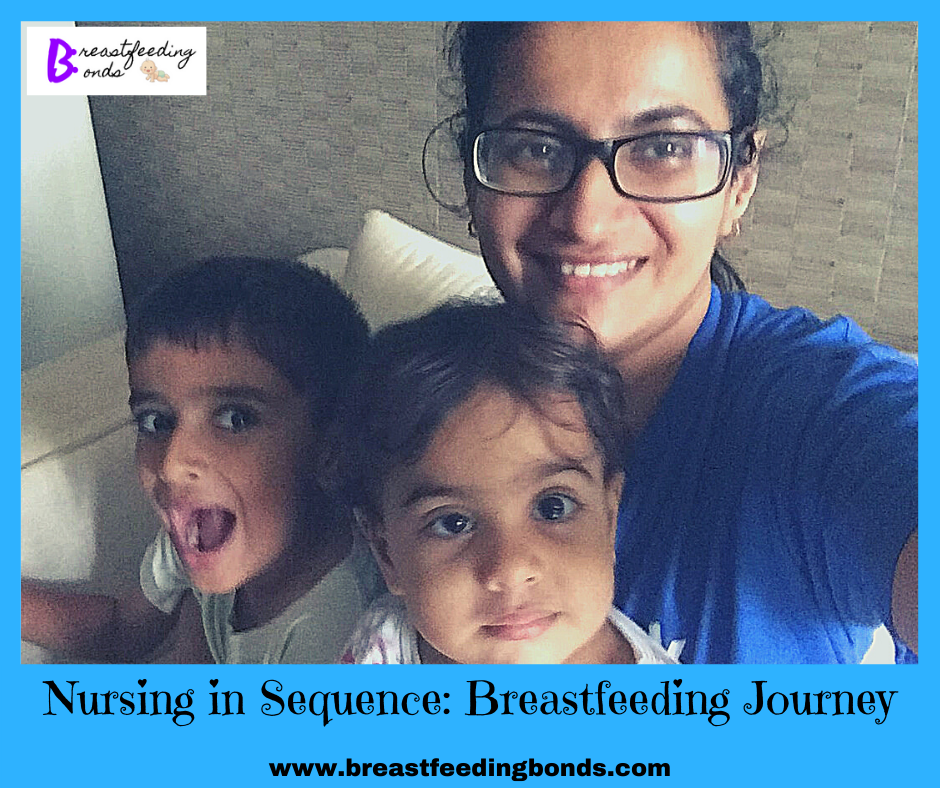
A software engineer, Meghna Antani, used to work full time till she delivered her son in May 2012. When on maternity leave, she had to move and hence quit her job. She is now a full time mommy to her two children. Let’s read through her beautiful journey, nursing in sequence. 1. Meghna, how was preparation vs. initiation of breastfeeding? While pregnant in 2012, the literature recommended and available was not the best. I read “What to expect when you’re expecting” many times. I thought I was prepared for labour and delivery. And that breastfeeding should be instinctive. My son was born with an emergency cesarean at about 8pm on a Sunday. He demanded to feed and latched on fairly well for the situation, as soon as he was to brought to me in the recovery room. With the still fresh wound, It was a challenge to turn to my side, but somehow I was able to position him. He wanted to take a long feed and sleep with me. The nurses thought I needed to rest myself. So he would feed for about half an hour and then cry when taken outside. I couldn’t rest even if I wanted to; not much because I could only hear my newborn’s wails. The nurses would entertain him for another half to one hour and bring him back to feed and hopefully sleep. I think they also gave him a feed of formula. The cycle continued till 5:30 in the morning, when I simply asked the nurse to go away and leave me with the baby. I covered him and nursed him to sleep. After waking up, I needed another incision for the IV as it had collapsed from the entire baby holding and positioning. They asked me to be careful as it took many incisions. 2. So, it basically was a smooth journey? The breastfeeding journey was not very challenging, he fed well. The only hitch was the lactation counsellor (LC) recommending to sit and feed, space out feeds, limit the feeds to certain time every few hours. To my regret, I followed this advice till seeing the paediatrician after a week. He advised to feed on demand and use any comfortable position. I lied down to nurse. The breastfeeding journey was smooth from that point onward; baby’s pee count was good. I did get tired from constant nursing and used to attempt to go out of baby’s sight once or twice a day. Learnt about baby carriers and tried one commercially available option at about 6 weeks, it was a resounding fail. I did not know enough about ergonomic babywearing or would have tried something (I regret not knowing enough then, it was a boon with my second). 3. You breastfed your son till he turned 4. Can you tell us a little about the journey? My son breastfed on demand till he was about 17-18 months. Slowly, I started distracting from few daytime demands and focusing on food intake. By the time he was 2 years, he was down to breastfeeding before nap and bed, after wake up, and during night wake up. I relaxed it based on the situation; when he was teething or sick he fed on demand. In another few months, I dropped the wake up feeds and offered food instead. He continued to nurse before nap and bedtime (and night wake up) till he weaned. Towards the end, it was down to exactly 3 feeds, 1 each before nap and sleep, 1 at dawn. We would read books at bedtime, and then he would feed to sleep. All attempts at getting him to wean were unsuccessful (we had to attempt night weaning because of carries), so we left it to his choice. At some point after his 4th birthday, he had a very large and painful ulcer near the lips which interfered in latching. He was still going strong at 4 years with no signs of quitting, and within 5 days was weaned. I continued to read before bed and he slept in the same position as before, minus the breastfeeding. At dawn, I patted him back to sleep. He stopped napping the day he refused to feed. So, with a combination of stopping breastfeeds and stopping the afternoon nap, he started sleeping for about 10 hours uninterrupted. I was also working on night pee training. An illness warrants a visit to a doctor; similarly take breastfeeding difficulties to a LC. 4. Indeed a beautiful journey! How was the beginning with your daughter? I found out that I was pregnant around the same time that he weaned. So it was pure luck that I didn’t have to worry about nursing through pregnancy or weaning or tandem nursing. I continued to sleep with him, till he started jumping on my tummy to wind down. We used a queen sized bed so my husband slept in another room to give us space. After a few weeks into pregnancy, I switched places with my husband. We continue the arrangement now, I sleep with the younger and husband sleeps with the older. Pregnancy was smooth apart from horrid nausea. I delivered a girl on a Friday in January 2017 at about 8 am. She was born in a VBAC (Vaginal Birth after C-section). As soon as I was sutured and given leave from the labour room, within 20 minutes after birth, she was breastfed. She was jaundiced, didn’t demand feeds, and preferred to sleep when swaddled. The latch was shallow. I was feeding a 4 year old before the pregnancy so maybe my perception was skewed. I figured out a pattern where I would strip her down to change diaper then nurse back to sleep. We saw very few pee diapers till after discharge. 5. Did it get better after you got home? I think there was no pee for over 24 hours. But the doctor was not worried. He asked us to wait for 36 hours and keep feeding. After discharge,
Challenging Obstacles: Breastfeeding Journey

Parigna Pandya Shah loves challenging obstacles through her determination, perseverance and hard work. Before we see it through her breastfeeding journey, let us learn a little more about her. Parigna completed her Masters in Counselling Psychology and a Masters in Gujarati Literature. She was awarded a gold medal for topping the University. Parigna began learning Indian Classical Music at the age of 6 and has sung for ads, TV serials, private albums and for Gujarati and Hindi films till college years. Post her 12th grade, she got into dubbing and went on to become a full time voice artiste. Some of her appreciated dubbing jobs are Hermione Granger in Harry Potter, Peaches in Ice Age, Gwen in Ben 10 and Chhota Bheem in Chhota Bheem. Other films (dubbing) in her kitty include Angry Birds (movie), Independence Day, Resurgence, X-men and more. The Disney approved singing voice of Minnie Mouse is hers. She has also explored the field of acting by doing a couple of Gujarati plays called ‘Jaagine joun to – Narsainyo, ek musical gatha’ and ‘Mari Vani, Meghani Sarvani’ with renowned actor Utkarsh Mazumdar. She also did a serial called ‘Muktibandhan’ for Colors TV in 2011 and acted in a short film ‘Kabira calling’. When asked, Parigna describes herself as a psychologist by education, singer/dubbing artiste by profession and an actor by passion. Post baby, she does selective work and her most recent prestigious project was voicing (hindi) for Emma Stone in her latest movie – Battle of the sexes. 1. Very impressive profile, Parigna. Were you prepared for this new journey you were to embark on? The hospital I chose to deliver in followed the Baby-friendly Hospital Initiative (BFHI). The gynaecologist(s) are staunch supporters of breastfeeding and are active in the Maharashtra chapter of Breastfeeding Promotion Network India (BPNI). From when a woman is pregnant, breastfeeding is promoted. The classes that are arranged are not only for the expecting mothers but also for the fathers; to introduce them to the importance and basics of breastfeeding. I had taken a prenatal class along with my family members with a lactation consultant (LC) working at my birthing facility. I learnt about its importance, challenges, common issues and their solutions; in theory. I had seen my mom nursing my younger sister. I had also seen other women in my extended family nursing their babies. So I thought, how hard could it be! 2. It looked like a good start. A little theory knowledge helps you recognize a situation. How much did it help you? I had a normal delivery and I nursed my baby right on the delivery table; just a few minutes after she was born. The first two days were pretty uneventful apart from the major sleep deprivation that was paving its way through my life, for years to follow. 😉 My milk volume increased on the third day leaving me super engorged pretty soon. It was not only difficult to latch the baby on the breast hard as rock, but next to impossible to be able to express without going through excruciating pain. People tried to help; from my husband to my mom and sister. The LC taught me the expression technique, but it was too painful to even touch my breasts. None of us could bring ourselves to inflict so much pain upon me. A nurse, of course with the right intentions, volunteered and expressed with totally wrong techniques. This led to bruising of my right breast and it continued to pain for a month. I can easily mark that day as the toughest day in my life with regards to enduring physical pain. Simultaneously, my baby developed neonatal jaundice. They gave her light therapy in my room itself. The physical pain of engorgement coupled with emotional pain of seeing that tiny thing in a box under blue lights was overwhelming. 3. Definitely not the start you had expected. Did things get better once you got home? Fortunately, things seemed to get better after a day and we came home. I have always been a very sincere and dedicated person. I try to give my best in everything I do. And if I can’t do something to the best of my abilities, I don’t do it at all. But in certain things, you can’t quit. Some things are too important to be left at the mercy of fate; breastfeeding is one of those. I had a mission in front of me – ‘6 months of exclusive breastfeeding’. So, I put alarms and nursed my baby every 2 hours. We were called the next evening for a weight check. My baby had lost 90 grams of her weight in 24 hours. Shocked, we immediately rushed to the pediatrician. She checked and observed her and told us that Aaratrika is lethargic. Her fingertips and soles were slightly blue and she wasn’t nursing efficiently. The pediatrician was surprised. She had been coming to the maternity home where I delivered from day one. As per her, my baby was the most active baby around. She advised my daughter’s admission to NICU for observation. 4. I got goosebumps. I cannot even imagine your plight. What happened next? I was in the general ward of the children’s hospital smelling my baby’s clothes. I thought I had lost her. There was no bed/room available at the hospital and I stayed the night with my husband sitting on the staff bed. And I went inside the NICU every couple of hours to nurse my baby. Eventually we had to be in the hospital for 3 more nights. They did numerous tests on her. All the reports were perfectly fine. The doctors came to the conclusion that the baby must not have received enough milk because of my super engorged breasts. Apparently, the baby was suckling, but was unable to transfer any milk. This really shattered me. As a mother, I had to just feed the baby. But, I couldn’t do that as well! The
